
Info & Resources
We've included helpful information and resources to support skaters and families throughout the season. Explore the tabs below for easy access to policies, guides, and important sport-specific information.
Club Policies & Procedures
Skater Code of Conduct
All skaters are expected to follow our Skater Code of Conduct to help create a safe, respectful, and positive environment on and off the ice. Please review the full policy here: Skater Code of Conduct
Parent Code of Conduct
All parents are expected to follow our Parent Code of Conduct to help create a safe, respectful, and positive environment on and off the ice. Please review the full policy here: Parent Code of Conduct.
KidSport Policy
KidSport is a local program that supports children who need financial assistance with sport registration fees and equipment costs. Skate Martensville is fortunate the sport of skating meets KidSport’s eligibility requirements. As such, members of Skate Martensville who face financial barriers are entitled to apply for a KidSport grant.
KidSport applications are typically due around the same time the Skate Martensville’s season begins. If the application is approved, it can take several weeks for Skate Martensville to receive the funding therefore, a $100 deposit will be required in lieu of the full registration fee and must be paid before a skater is allowed on the ice. Once the KidSport funding arrives, the grant amount will be applied to the skater’s registration fees. If there are any outstanding fees not covered by KidSport, the skater will be notified with an invoice and payment will be due immediately. If KidSport covers all or part of the $100 deposit, the skater will receive a refund for that amount.
*Skate Martensville’s fundraising deposit requirement is not eligible to be covered by KidSport grants as per KidSport’s policies.
Please follow these directions to register if applying for Kidsport:
- Skaters must notify Skate Martensville by email to skatingclub1@gmail.com.
- The email above must include proof of a KidSport application submission (example of proof could be a screenshot or application form attached to email).
- At the time of registration, please select the e-transfer payment option.
- Send your $100 deposit as per the instructions on your invoice prior to the start of skating.
Late Registration Policy
Late registrations may be accepted after the beginning of the season at the discretion of the club's Executive if spots are available. Requests or inquiries can be sent to skatemville.reg@gmail.com.
Refund Policy
Prior to the onset of the skating season:
- Refund requests, along with a general explanation, must be submitted by September 30.
- Please email your request to skatemville.reg@gmail.com.
- All registration fees will be refunded, minus a $25 administration fee.
During the skating season:
- A refund can be given on a prorated basis for physical injuries that would prevent a skater from continuing to the end of the season. A medical professional’s or physiotherapist’s certificate/note must be submitted ¹. Requests must be made within 14 days of the injury. Refunds will be based on program fees only (less a $25 administration fee) and will be prorated from the last day of skating ².
- A refund can be given on a prorated basis if a skater has moved 60 km or more outside of Martensville city limits. Refunds will be based on program fees only (less a $25 administration fee) and will be prorated from the last day of skating ².
- A refund can be requested for first-time skaters registered in a Pre-CanSkate program if the coach feels the skater is not yet ready to participate AND after attending the first two consecutive lessons. Refunds must be requested before the end of the fourth lesson of the Pre-CanSkate program. Refunds will be based on program fees only (less a $25 administration fee) and will be prorated from the last day of skating ².
- Refund requests will not be accepted after March 1.
- Requests for refunds must be sent in writing to Skate Martensville Club: skatemville.reg@gmail.com
- Approved refund requests will be processed within 2 weeks.
- All refund requests must contain the following information:
- First and Last name of skater
- Email address
- Last day of skating (if applicable)
- Details of request (including a doctor's note/certificate if applicable)
¹ Recognized by the College of Physicians and Surgeons of Saskatchewan.
² Refunds will not include the Skate Canada membership or the Skate Saskatchewan fee.
Dispute Resolution Process
All members of Skate Martensville are expected to follow the Dispute Resolution Process to ensure concerns are addressed in a fair and respectful way. Please review the full policy here: Dispute Resolution Process.
Skate Canada Membership
Skate Martensville is governed by Skate Canada's rules and regulations. Skate Canada requires all persons who use the ice to have a Skate Canada membership number. This membership provides insurance coverage in case of an injury sustained while on the ice, among many other benefits. The benefits of belonging to Skate Canada are many. Here are just a few:
- Your child will be a member of Skate Canada, the national governing body for figure skating in Canada.
- Your child will receive an identification number that has been recorded at the National Office of Skate Canada. This number will not change and remains your child's link to Skate Canada forever; even in years you are not an active member.
- Your child will need this registration number to participate in Skate Canada sanctioned events.
- Makes your child eligible to take Skate Canada tests, participate in Skate Canada competitions, ice shows and other sanctioned events.
- Privileges to enter the Members Only website of Skate Canada, that contains all the important information about the association.
- A member accident insurance benefit at a substantially lower cost than what is available in other sports is included in the membership fee.
- Access to high quality programs that are recognized and often sought after internationally and by other national sport organizations.
- Access to qualified, NCCP certified Skate Canada professional coaches who have been trained through high quality training programs developed by Skate Canada.
- National registry of figure skating qualifications (tests) and results (for qualifying events) held in a central computerized system for easy access.
For more information about Skate Canada, visit skatecanada.ca.
Skate Saskatchewan Membership
Skate Canada - Saskatchewan is a non-profit sport governing body who is affiliated with and governed by Skate Canada. The Skate Saskatchewan fee is used to off-set expenses which are used for:
- Competitions - Sask Skate, Sectionals, Winter Classic, Prairie Regional Synchronized Skating and Saskatchewan Winter Games District Run-Offs
- Skater Development Programs - STAR seminar, Black Boots Seminar, Road Show, Performance Camp, Spring Kick Off Camp
Skating Programs - Rising Star Seminars, CanSkate Enhancement Workshops - Coach Development - Club, Regional & Provincial Coach Courses, CanPowerSkate Coaches Course, MILE Project, Coaches’ Forum, Training & Certified Club and Regional Coaches Grant
- Officials Development - Clinics, Officials Exchange
- Athlete Assistance – Out-of-Province Competitions, travel assistance for Challenge & Canadians, Team Leaders for Challenge & Canadians
- Skate Canada – Saskatchewan Office Administration - Rent, power, phone and audit
- Equipment - Live streaming, computer equipment
Program Assistant Policy
Our CanSkate program wouldn’t be possible without the support of our dedicated Program Assistants (PAs). In order to meet the standards set by Skate Canada and ensure a positive experience for all skaters, we rely on the help of PAs to assist on and off the ice.
What Does a Program Assistant Do?
Program Assistants play a vital role in delivering the CanSkate program. Their responsibilities may include:
- Assisting coaches with on‐ice and off‐ice programming
- Demonstrating skills and teaching progressions
- Leading circuits, drills, and group activities
- Setting up and taking down teaching aids and equipment
- Taking attendance
- Supporting Ice Show choreography and leading CanSkate group performances
- Serving as a positive role model for younger skaters
PAs are typically STARSkaters or former Skate Canada members who volunteer their time to support the development of our CanSkate athletes. Their contributions make a big difference in the experience and success of our youngest skaters.
Who Can Be a Program Assistant?
The Program Assistant role is open to skaters who:
- Are at least 12 years of age, and/or
- Have successfully completed the STAR 1 Freeskate assessment
Eligible skaters can choose to opt in as a PA for the season during the registration process. All PAs are required to attend a training session before the start of the skating season. If your skater chooses to be a PA, you’ll receive information about training after registration.
Program Assistant Incentives
Program Assistant contributions will be recognized through an honorarium system.
Each Program Assistant will receive a credit of $5.00 per CanSkate session assisted. The total amount accumulated over the course of the season may be applied in one of the following ways:
- As a credit toward registration fees for the following skating season, or
- As a gift card to Top Shelf Sports, which may be used to purchase custom Skate Martensville apparel.
In addition to the honorarium, Program Assistants may be recognized for outstanding service through:
- A formal letter of acknowledgment from the club, suitable for inclusion in resumes or portfolios
- Credit towards high school volunteer hour requirement
PreCan, CanSkate, and CanHockey Information
What is CanSkate?
CanSkate is a learn-to-skate program that focuses on fun, participation and basic skating skill development. The program uses nationally-tested and proven curriculum and delivery methods that guarantee skater success in developing stronger basic skills and developing them faster. A series of balance, control and agility skills are taught in six stages of learning. Skaters progress at their own rate and coaches make sessions active using teaching aids, upbeat music and a wide variety of activities that create a motivational environment and promote learning. Badges, ribbons and other incentives are used to benchmark skaters’ progress and reward effort and participation.
As part of the CanSkate curriculum, Skate Martensville also offers a Pre-Can program for skaters ages 3-4. PreCan skaters are given the opportunity to get familiar with the ice and learn basic movements in a group setting.
Skate Martensville also offers a CanHockey option for U7 & U9 skaters who are interested in hockey-focused skating development. CanHockey skaters are challenged to develop and refine fundamental skating techniques to help improve their overall hockey game.
All sessions are lead by NCCP Certified coaches. To enable our club to deliver an effective program and to meet the requirements set out by Skate Canada, we require the help of trained Program Assistants to assist our young skaters on the ice. Program Assistants consist of STARSkaters and/or former Skate Canada members who volunteer their time both on and off the ice to assist our coaches in delivering the CanSkate program.
Helmet Policy
PreCan & CanSkate Clothing Recommendations
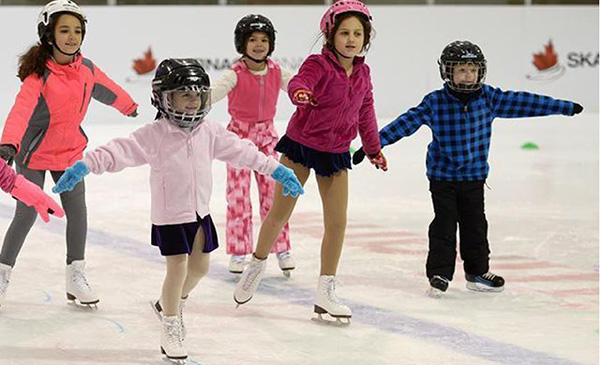
The rink can often feel cold to younger skaters who aren’t able to move as fast. Please dress your child warmly. Here is the recommended CanSkate attire for all skaters in Stages 1-6:
- Skaters should be warm and be able to move freely. Some snowsuits can make it difficult for the skaters to move (and get up).
- Suitable attire for both boys and girls are warm leggings/pants, a sweater, a jacket, and mitts/gloves. Please no fuzzy mitts/gloves as the fibres stick to the ice and become a hazard to other skaters.
- If the skater wears a scarf, it must be tucked in at all times.
- A dress or skirt for girls is fine but warm tights or leggings are necessary to remain comfortable.
Example:
CanHockey Attire Recommendations
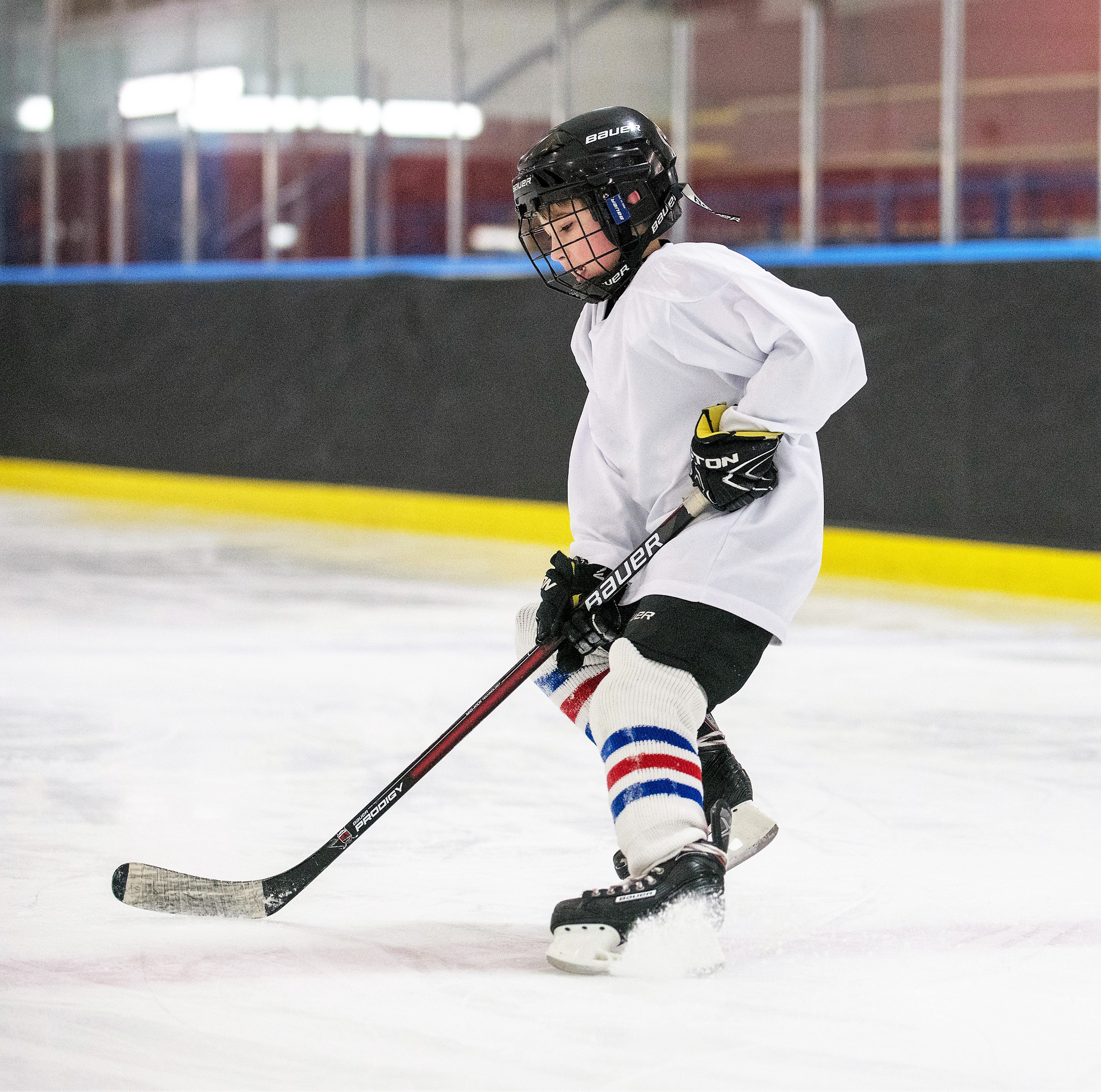
CanHockey participants are encouraged to wear full hockey gear including helmet, gloves and hockey skates. Skaters may also bring a hockey stick on the ice.
Example:
Skate Recommendations
Skate Sharpening
Proper sharpening keeps blades in good condition and helps skaters perform their best.
- Maintain the edges – Sharpening removes small nicks and keeps the edges smooth for safe, effective skating.
- Sharpen regularly – As a general guideline, skates should be sharpened about every 25 hours of ice time.
- At the CanSkate level, we recommend these local sharpening services:
- Top Shelf Sports, Martensville Recreation Centre: (306) 978-9800
- Atlas Outdoors, #2-501 Neufeld Street, Warman: (306) 500-0369
Fundraising
Fundraising plays a vital role in helping us keep fees affordable and continue offering high-quality programming to all our skaters.
- Each family is required to sell a minimum of $250 in fundraising products (based on total sales, not profit) throughout the season.
- A $200 fundraising deposit will be collected at the time of registration. This can be paid by credit card or e-transfer (no more cheques!).
- Once the $250 fundraising minimum is met, the $200 deposit will be refunded via e-transfer.
Families will have multiple opportunities to meet this fundraising requirement, including two annual fundraisers and club sponsorship options. For full details, visit: skatemartensville.ca/pages/
Ice Show
The year-end ice show (aka, Carnival) is an opportunity for skaters to show off the skills they acquired throughout the skating season. Skaters are assigned groups and provided music and choreography to perform. Parents, friends and family are encouraged to come out to the rink to watch and cheer on their CanSkater. The ice show ends with presenting the annual club awards.
The three weeks leading up to the Ice Show will be dedicated to preparation and practicing routines. 1-day skaters in CanSkate/PreCan are encouraged to attend both Tuesday AND Thursday skating sessions to learn their assigned routine. All PreCan & CanSkaters are expected to attend both the Dress Rehearsal and the Ice Show. Please check the Club Calendar for specific dates and times.
Further details for the Carnival (ie. theme, music, routines, costumes, etc.) will be available by the end of January.
PreSTAR Information
What is PreSTAR?
Helmet Policy
Clothing Recommendations
Skate Recommendations
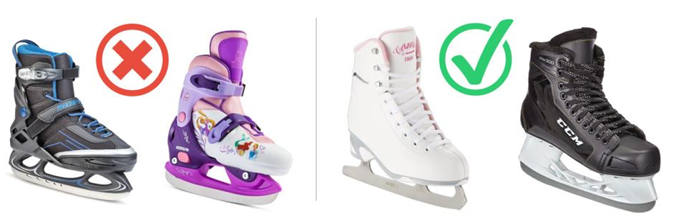
Figure skates are mandatory for all PreSTAR skaters.
Purchasing the right figure skates for your skater’s level and your budget is very important. Well-fitted skates not only make skating more enjoyable but also help skaters progress more quickly. For guidance on the best boots and blades, speak with your skater’s coach.
Purchasing Skates
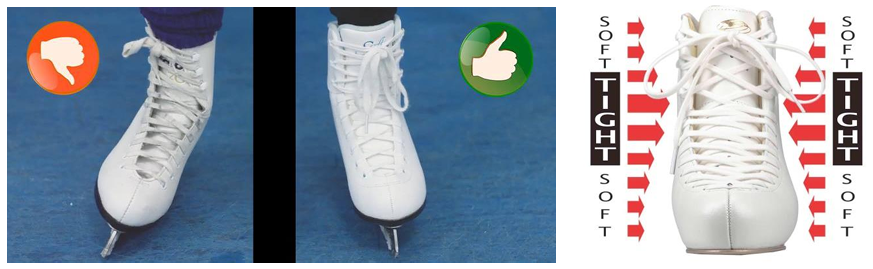
If you’re buying new, we recommend visiting an experienced figure skate fitter. A proper fitting usually takes 1–3 hours, but it’s worth the time—it helps prevent injuries and makes skating more comfortable and fun. Bring your child’s old skates and the socks or tights they usually wear so the fitter can get the best fit possible.
Even new, heat-molded skates need some break-in time. Walking around the house in them (properly tied) or doing a few squats can help speed things up. Sometimes small adjustments are needed, like punching out the ankle area—this should always be done by someone experienced.
Recommended retailers who carry figure skates appropriate for PreSTAR:
- Al Anderson's Source for Sport
208 Avenue B South
Saskatoon, SK - Atlas Outdoors Cycle and Recreation
501 Neufeld St #2
Warman, SK - Ballet to Broadway
232 High Street West
Moose Jaw, SK
Book a fitting with Bree Campbell (306-681-4846) or Carime Molde (306-630-4504) - ProSkate
16972 111 Avenue NW
Edmonton, AB
Book a fitting: 780-481-5532
Buying Used Skates
You don’t have to spend a fortune on skates—there are often great secondhand options at local stores or online, especially at the start of the season. Just make sure the boots aren’t overly worn or creased around the ankles, and that the blades still have enough life left to be sharpened. Sometimes used boots need small adjustments for comfort, which a pro can do for you.
Caring for Skates
With a little care, skates can last a long time:
- Wipe blades and boots dry after every use.
- After drying, store the blades in a cloth blade protector to help prevent rust.
- Let skates air out after practice—sweaty boots can break down the leather.
- Always wear guards when walking to/from the ice surface. NEVER walk on floors or rubber mats with unprotected blades.
- Don’t sharpen skates the night before a test or competition.
Skate Sharpening
Proper sharpening keeps blades in good condition and helps skaters perform their best.
- Maintain the edges – Sharpening removes small nicks and keeps the edges smooth for safe, effective skating.
- Sharpen regularly – As a general guideline, skates should be sharpened about every 25 hours of ice time.
- At the PreSTAR level, we recommend these local sharpening services:
- Atlas Outdoors, #2-501 Neufeld Street, Warman: (306) 500-0369
Fundraising
Fundraising plays a vital role in helping us keep fees affordable and continue offering high-quality programming to all our skaters.
- Each family is required to sell a minimum of $250 in fundraising products (based on total sales, not profit) throughout the season.
- A $200 fundraising deposit will be collected at the time of registration. This can be paid by credit card or e-transfer (no more cheques!).
- Once the $250 fundraising minimum is met, the $200 deposit will be refunded via e-transfer.
Families will have multiple opportunities to meet this fundraising requirement, including two annual fundraisers and club sponsorship options. For full details, visit: skatemartensville.ca/pages/
Ice Show
The year-end ice show (aka, Carnival) is an opportunity for skaters to show off the skills they acquired throughout the skating season. Skaters are assigned groups and provided music and choreography to perform. Parents, friends and family are encouraged to come out to the rink to watch and cheer on their CanSkater. The ice show ends with presenting the annual club awards.
The three weeks leading up to the Ice Show will be dedicated to preparation and practicing routines. 1-day skaters in CanSkate/PreCan are encouraged to attend both Tuesday AND Thursday skating sessions to learn their assigned routine. All PreCan & CanSkaters are expected to attend both the Dress Rehearsal and the Ice Show. Please check the Club Calendar for specific dates and times.
Further details for the Carnival (ie. theme, music, routines, costumes, etc.) will be available by the end of January.
STARSkate Information
What is STARSkate?
Assessments
Assessing is a part of Skate Canada’s STARSkate program. Assessments are designed to assist skaters’ development in a progressive manner. Skaters may move through the STAR assessment structure at their own pace per discipline. For example, a skater may be working on STAR 3 Skills, STAR 1 Dance, and STAR 2 Freeskate.
Assessments may be done at any time throughout the season. Your coach will decide when a skater is prepared for an assessment and will advise the parent/guardian when an assessment will be done. Depending on the level and discipline, assessments are either conducted by the skater’s coach or an evaluator.
Assessment Attire
Regular practice attire is acceptable for STAR 1 and 2 assessments. Performance attire is recommended for assessments higher than STAR 2. Gloves and jackets may be worn for warm-up but should be removed for the assessment (if temperatures allow). Hair should be neat and pulled back away from the face. Skates and laces should be clean and tidy.
Competitions
Competitions are completely optional, but highly encouraged by our coaches.
Why Competitions?
- Performing: Competition exposes skaters to the spotlight. Being comfortable performing solo in front of a crowd is an important life skill that can be applied to other aspects of life such as school and work. This skill is also required for skating tests when being evaluated in front of a judge at test days.
- Motivation: Competition keeps skaters motivated. Skaters work towards a given task (program) with a deadline (competition day) and a goal in mind (to perform their best). Most skaters practice with more determination and purpose when they know a performance is coming up.
- Progress: This is your skater’s chance to shine and show off the skills they’ve accomplished throughout the season. It’s also a chance to gain feedback from an evaluator as to how your skater is doing at their level and what they need to work on.
- Team Bonding: Competitions are a great time for skaters to cheer on their peers and encourage one another as they perform on the ice. Skaters have fun making posters and showing their club pride throughout the competition. Even though figure skating is considered an individual sport, some of the best memories and friendships are formed between skaters at competitions.
What to Expect at Competition
- STAR 1 introduces skaters to performing elements in a choreographed mini program without music.
- STAR 2 & 3 introduces skaters to performing elements in a choreographed program to music. It is very similar to higher level events where there is a timed warm-up for each group of skaters followed by performances of individual programs. Judges assess each skater based on standards set by Skate Canada. At the conclusion of the STAR events, each skater is presented with a report card and a ribbon or rosette corresponding to their overall assessment.
- STAR 4 and up marks the entry point into competitive skating where skaters are scored and ranked. Medals are awarded to the top 3 finishers. All competitors receive a report card listing assessments for each element and program component as well as their overall ranking.
Competition Dates
Competition dates are typically announced at the beginning of the season. Communication about upcoming competition opportunities will be communicated when Skate Martensville receives a technical package from the host club. If you have questions about upcoming competitions, please speak with your coach.
Skate Recommendations
Skate Sharpening
Proper sharpening keeps blades in good condition and helps skaters perform their best.
Sharpening tips:
- Brand new skates should always be sharpened before the first use.
- Plan on sharpening your skates every 20–40 hours / 4-8 weeks of ice time (or sooner if they feel slippery or get nicked).
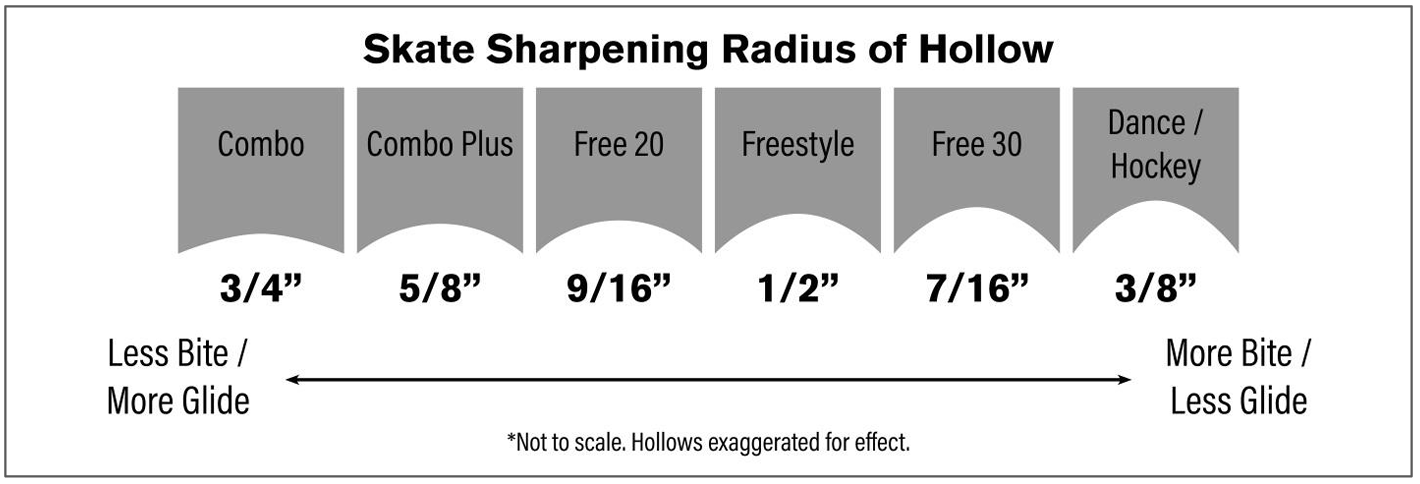
- Beginners often start with a Combo Plus (5/8”) sharpening. As skaters progress and start more complex skills, they may want to move to a Free 20 (9/16”) or Freestyle (1/2”).
Local sharpeners who are trained in sharpening figure skates:
- Atlas Outdoors, #2-501 Neufeld St., Warman: 306-500-0369
Sharpening guide:
Practice Attire
Skate Martensville asks all STARSkaters to follow the recommended practice attire to promote:
- A safe and positive learning environment
- A healthy self-image
- Respect for self and others
At the STARSkate level, coaches need to see a skater’s body alignment to provide proper feedback. For this reason, form-fitting, stretchy clothing is preferred over tight, restrictive, or overly loose clothing.
Recommended Attire:
- Clothing: Wear athletic clothing in layers. Clothes should be form-fitting or close to it, allowing coaches to see body lines for proper technique.
- Skating dresses: Girls are encouraged to wear a skating dress with beige tights to simulate performance attire. A snug sweater or zip-up can be layered on top.
- Gloves/mittens: Acceptable during practice, but coaches may ask for bare hands during lesson time for choreography.
- Hair: Hair should be tied back or pulled up, away from the face. Long hair can be in a bun, braid, or neat ponytail. Bangs should be pinned or cut short to prevent distraction.
- Clothing restrictions: Baggy clothing (sweats, pajama pants, loose sweaters, bunny hugs), restrictive clothing (jeans), or revealing clothing (low-rise pants, crop tops, short shorts, transparent material) is not allowed.
- Jewelry: Small jewelry (earrings, rings, necklaces) is allowed if it is securely fastened and does not interfere with performance. Large, bulky, or dangling jewelry is not permitted.
- Coverage: Clothing must fully cover the chest, torso, and undergarments.
- Logos/graphics: Clothing must be free of inappropriate logos, phrases, or images.
Examples of Practice Attire:
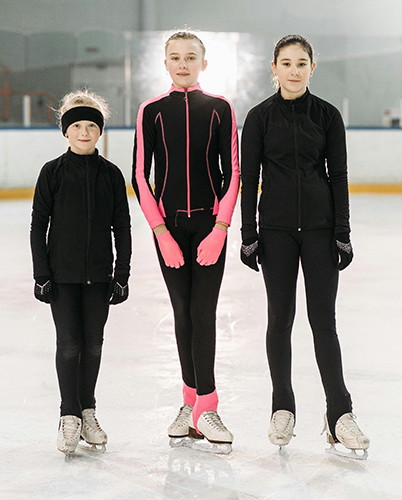
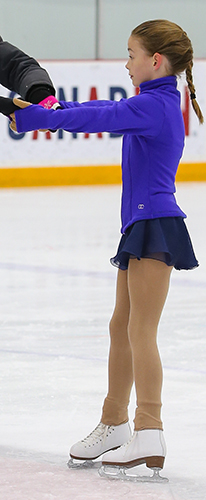
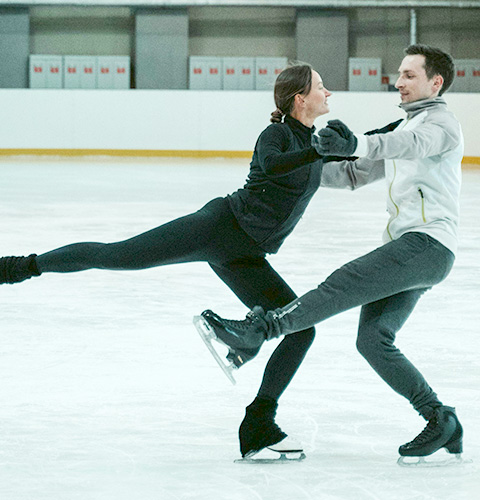
Any skaters who do not comply with the practice attire outlined above will be asked to leave the ice. If you are unsure about an article of clothing, please ask your coach.
Performance Attire
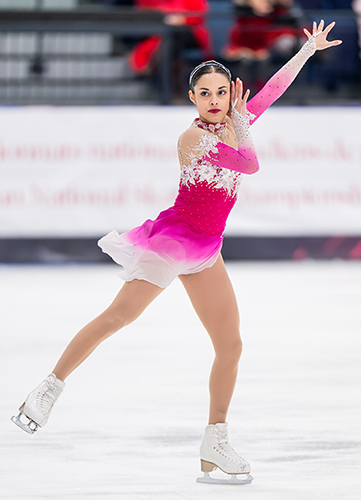
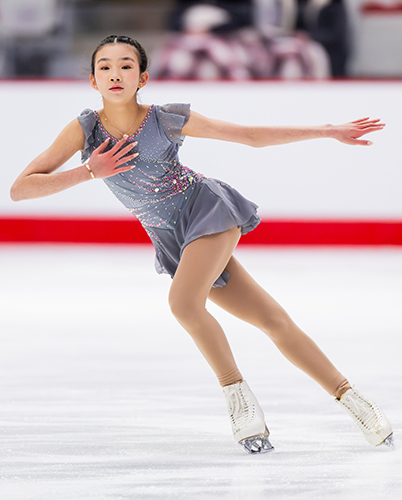
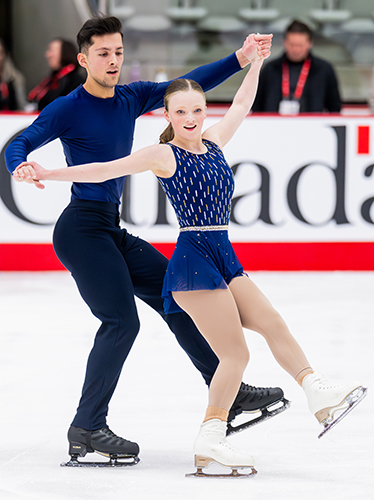
Your skater should look and feel their best for competitions, assessments, and ice shows. To help them shine on the ice, we recommend the following attire:
- Girls: Skating dress with beige tights are required.
- Boys: Black pants with a dress shirt are required.
- Practice in your outfit: Your skater should try out their performance attire a few times before the event to ensure it fits well, stays in place, and does not restrict movement.
- Tights: Should fit properly and be in good condition—no rips or pilling. It’s a good idea to pack an extra pair just in case!
- Skates: If tights don’t cover the boots, make sure skates are clean and polished.
- Hair: Must be securely tied back to prevent it from interfering with the performance. Long hair can be styled in a bun, braid, or neat ponytail. Use gel or hairspray to keep wispy hair in place.
- Warm-up clothing: Cotton mittens or a club jacket are fine during warm-up, but must be removed before the performance or assessment.
Examples of Performance Attire:
Mandatory Ice Show Attendance
All STARSkaters are expected to attend all choreography practices, Dress Rehearsal, and the Ice Show. Please check the Club Calendar for specific dates and times.
Because of the number of routines and the complexity of the choreography, all practices during March are mandatory for STARSkaters. Any skater who misses more than two practices in March will not be permitted to perform in the Ice Show.
If you anticipate being absent in March, please notify your coach as soon as possible so they can make the necessary arrangements.
Further details for the Carnival (ie. theme, music, routines, costumes, etc.) will be available by the end of January.
Fundraising
Fundraising plays a vital role in helping us keep fees affordable and continue offering high-quality programming to all our skaters.
- Each family is required to sell a minimum of $250 in fundraising products (based on total sales, not profit) throughout the season.
- A $200 fundraising deposit will be collected at the time of registration. This can be paid by credit card or e-transfer (no more cheques!).
- Once the $250 fundraising minimum is met, the $200 deposit will be refunded via e-transfer.
Families will have multiple opportunities to meet this fundraising requirement, including two annual fundraisers and club sponsorship options. For full details, visit: skatemartensville.ca/pages/fundraising.
Synchronized Skating Information
Practice Attire
Skate Martensville asks all synchro skaters to follow the recommended practice attire to promote:
- A safe and positive learning environment
- A healthy self-image
- Respect for self and others
At the STARSkate level, coaches need to see a skater’s body alignment to provide proper feedback. For this reason, form-fitting, stretchy clothing is preferred over tight, restrictive, or overly loose clothing.
Recommended Attire:
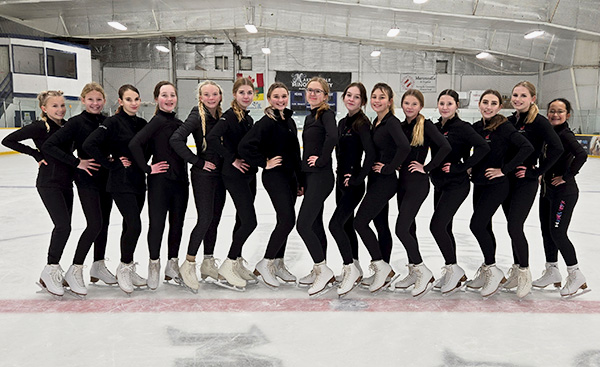
- Black: All apparel must be black in colour.
- Clothing: Wear athletic clothing in layers. Clothes should be form-fitting or close to it, allowing coaches to see body lines for proper technique.
- Gloves/mittens: Acceptable during practice, but coaches may ask for bare hands during lesson time for choreography.
- Hair: Hair should be tied back or pulled up, away from the face. Long hair can be in a bun, braid, or neat ponytail. Bangs should be pinned or cut short to prevent distraction.
- Clothing restrictions: Baggy clothing (sweats, pajama pants, loose sweaters, bunny hugs), restrictive clothing (jeans), or revealing clothing (low-rise pants, crop tops, short shorts, transparent material) is not allowed.
- Jewelry: Small jewelry (earrings, rings, necklaces) is allowed if it is securely fastened and does not interfere with performance. Large, bulky, or dangling jewelry is not permitted.
- Coverage: Clothing must fully cover the chest, torso, and undergarments.
- Logos/graphics: Clothing must be free of inappropriate logos, phrases, or images.
Example of synchro practice attire:
Any skaters who do not comply with the practice attire outlined above will be asked to leave the ice. If you are unsure about an article of clothing, please ask your coach.
Performance Attire
The Coach and/or Team Manager will provide a list of items that shall be worn for the season’s competitions and performances. This includes but is not limited to a dress, hair style, tights, makeup, and accessories such as scrunchies or hair pieces. These items will be discussed at the synchro team meeting.
Competitions
The number of competitions attended in a season will be at the discretion of the coach and team members.
What to Expect
Synchro teams are evaluated on either one or two skates, depending on the competition. The team receives a score for each skate and is ranked based on their performance(s). Medals are awarded to the top 3 finishers. All teams receive a report card listing assessments for each element and program component as well as their overall ranking.
All skaters are expected to stay with the team for the full day. Skaters are asked not to leave the arena throughout the day until the team is completely finished. Unlike a singles competition, if a skater is late returning for their event, it affects the entire team, not just the individual. It is extremely important for all skaters to be on time for all activities. Skaters will be attending competitions as a club and the expectation is that all skaters remain with their team for the full day until they are excused by the coach. The team will sit together in the stands to cheer on fellow skaters and to watch other synchro teams. Competitions are a great learning experience for all!
Competition Dates
Competition dates are typically announced at the beginning of the season. Communication about upcoming competition opportunities will be communicated by the coach and/or Team Manager.
Ice Show
The year-end ice show (aka, Carnival) is an opportunity for skaters to show off the skills they acquired throughout the skating season. Synchro teams will perform their competition program at the ice show. Parents, friends and family are encouraged to come out to the rink to watch and cheer on the synchro teams and club skaters. The ice show ends with presenting the annual club awards.
All synchro skaters are expected to attend both the Dress Rehearsal and Ice Show. Please refer to the Club Calendar for dates and times.
Skate Recommendations
Purchasing the right figure skates for your skater’s level and your budget is very important. Well-fitted skates not only make skating more enjoyable but also help skaters progress more quickly. For guidance on the best boots and blades, speak with your skater’s coach.
Purchasing Skates
If you’re buying new, we recommend visiting an experienced figure skate fitter. A proper fitting usually takes 1–3 hours, but it’s worth the time—it helps prevent injuries and makes skating more comfortable and fun. Bring your child’s old skates and the socks or tights they usually wear so the fitter can get the best fit possible.
Even new, heat-molded skates need some break-in time. Walking around the house in them (properly tied) or doing a few squats can help speed things up. Sometimes small adjustments are needed, like punching out the ankle area—this should always be done by someone experienced.
Recommended retailers who carry figure skates appropriate for STARSkate:
- Ballet to Broadway
232 High Street West
Moose Jaw, SK
Book a fitting with Bree Campbell (306-681-4846) or Carime Molde (306-630-4504) - ProSkate
16972 111 Avenue NW
Edmonton, AB
780-481-5532
Buying Used Skates
You don’t have to spend a fortune on skates—there are often great secondhand options at local stores or online, especially at the start of the season. Just make sure the boots aren’t overly worn or creased around the ankles, and that the blades still have enough life left to be sharpened. Sometimes used boots need small adjustments for comfort, which a pro can do for you.
Caring for Skates
With a little care, skates can last a long time:
- Wipe blades and boots dry after every use.
- After drying, store the blades in a cloth blade protector to help prevent rust.
- Let skates air out after practice—sweaty boots can break down the leather.
- Always wear guards when walking to/from the ice surface. NEVER walk on floors or rubber mats with unprotected blades.
- Don’t sharpen skates the night before a test or competition.
Skate Sharpening
Proper sharpening keeps blades in good condition and helps skaters perform their best.
Sharpening tips:
- Brand new skates should always be sharpened before the first use.
- Plan on sharpening your skates every 20–40 hours / 4-8 weeks of ice time (or sooner if they feel slippery or get nicked).
- Beginners often start with a Combo Plus (5/8”) sharpening. As skaters progress and start more complex skills, they may want to move to a Free 20 (9/16”) or Freestyle (1/2”).
Local sharpeners who are trained in sharpening figure skates:
- Russ Prosko (by appointment only), Saskatoon: 306-384-0341
- Atlas Outdoors, #2-501 Neufeld St., Warman: 306-500-0369
Sharpening guide:
Fundraising
Fundraising helps offset the extra costs of costumes, competitions, coaching, and travel. Fundraising options are at the descretion of each team and are discussed at the synchro team meeting.
Role of a Spare
What is a “Spare”?
A Spare is a valued team member who trains alongside the team but does not skate in the official program during competition unless called upon.
Who is a Spare?
A skater may be designated as a Spare for several reasons:
- They are unable to attend competitions.
- They have missed practices and are not fully prepared to compete.
- They choose to be a Spare if they cannot fully commit to competition due to personal circumstances but still want to contribute to the team.
No matter the reason, stepping into the role of a Spare reflects true dedication. It demonstrates a commitment to the team’s success and showcases a skater’s resilience, adaptability, and unwavering support for their teammates.
What does a Spare do?
- At Practices:
- Step into any position when a teammate is absent.
- Train alongside the full team every step of the season.
- Master every role and element, staying flexible and prepared to jump in at a moment’s notice.
- At Off-Ice Sessions:
- Learn footwork and choreography alongside the full team.
- Step into any position when a teammate is absent.
- At Competitions:
- Be on standby in full costume, makeup, and skates—ready to compete if required.
- Take part in competition practices and warm-up stroking exercises.
- Leave the ice before the program begins unless they are stepping in to skate.
- At the Ice Show:
- Spares are included in the team’s year-end ice show performance, provided they are available and willing to participate.
- This gives every skater the opportunity to celebrate the season and showcase their hard work in front of family, friends, and the community.
Why being a Spare is important
- Injury Management: Having a trained spare skater ensures that the team can still compete if a skater is injured or unable to participate in a competition.
- Team Depth: It adds depth to the team, allowing for more strategic flexibility in case of unexpected events.
- Development: Spares develop resilience, leadership, and a deep understanding of team dynamics — skills that make them stronger skaters and teammates.
Being a Spare takes dedication, adaptability, and heart. It is not a “lesser” role — it is a role of trust. Spares embody true team spirit: prepared, dependable, and always ready to rise when the team needs them most.